Trekking in DongBei

SITTING tight for four hours inside a budget plane, on the tarmac, is a test of patience. My destination, Harbin, was only 2.5 hours from Shanghai, about half the time spent squeezing my body into a comfortable position during the delay. The loss of travel time was initially put down to fog, but when the airplane next to the one I patiently sat in took off ahead of time I knew it was all trickery - an all too common experience here in China. Why Chinese airport authorities are reluctant to allow a foreign budget airline take-off gets the rumor mill turning. Nobody has ever really confirmed the truth behind the delays. The number one reason Chinese people give is that the carrier, Spring Airlines, doesn’t have a good relationship with the authorities.
Finally as the plane descended into the
capital of HeiLongJiang (Black Dragon Province) it was difficult to make out
any buildings. The city was blanketed in snow. An exciting prospect for a guy from Western Queensland. The outside temperature lingered
around -16 degrees Celsius, a warm winter day for Dong Bei (North East China).
I took a bus to my hostel, and as the vehicle
slowly weaved its way into the city, it became a historical tour. Russian
architecture has stamped itself on this city. Its urban plan is European, its
buildings crowned with Russian architectural flare. Pedestrian bridge crossings
and bus stops showed the city’s colonial past, all colored green and gold and
with neo-classical architecture. Clear as ice, this is where China meets
Russia.

During the winter cold plenty of thrill
seekers head down to the river and race across the ice in their sedans.
Watching it at first made me wonder how strong the ice was beneath me. I didn’t
feel that comfortable. I didn’t know how strong the ice was. On the other hand
cocky motorists felt safe tackling the ice with their 4 wheels. A kind of
stay-at-home adventure.
The next day I took a 6 hour mini-van to a
village of only 2000 people. Of all my trips in China I have never been
somewhere as isolated or as small as this village. Xue Xiang – China’s home of
snow. The mini-van raced through undisturbed countryside and climbed steep mountains, covered in virgin forest, clean air and snow. Arriving at the one and only street in this remote village, heavy wind picked up, blowing
snow into my eyes. This reminded me of some dust storms in Western Queensland.
The hotel was clean and comfortable, with a small fire under the bed. Windows
were double-glass. The first thing that struck me here was that indoors,
residents were growing roses and cacti.
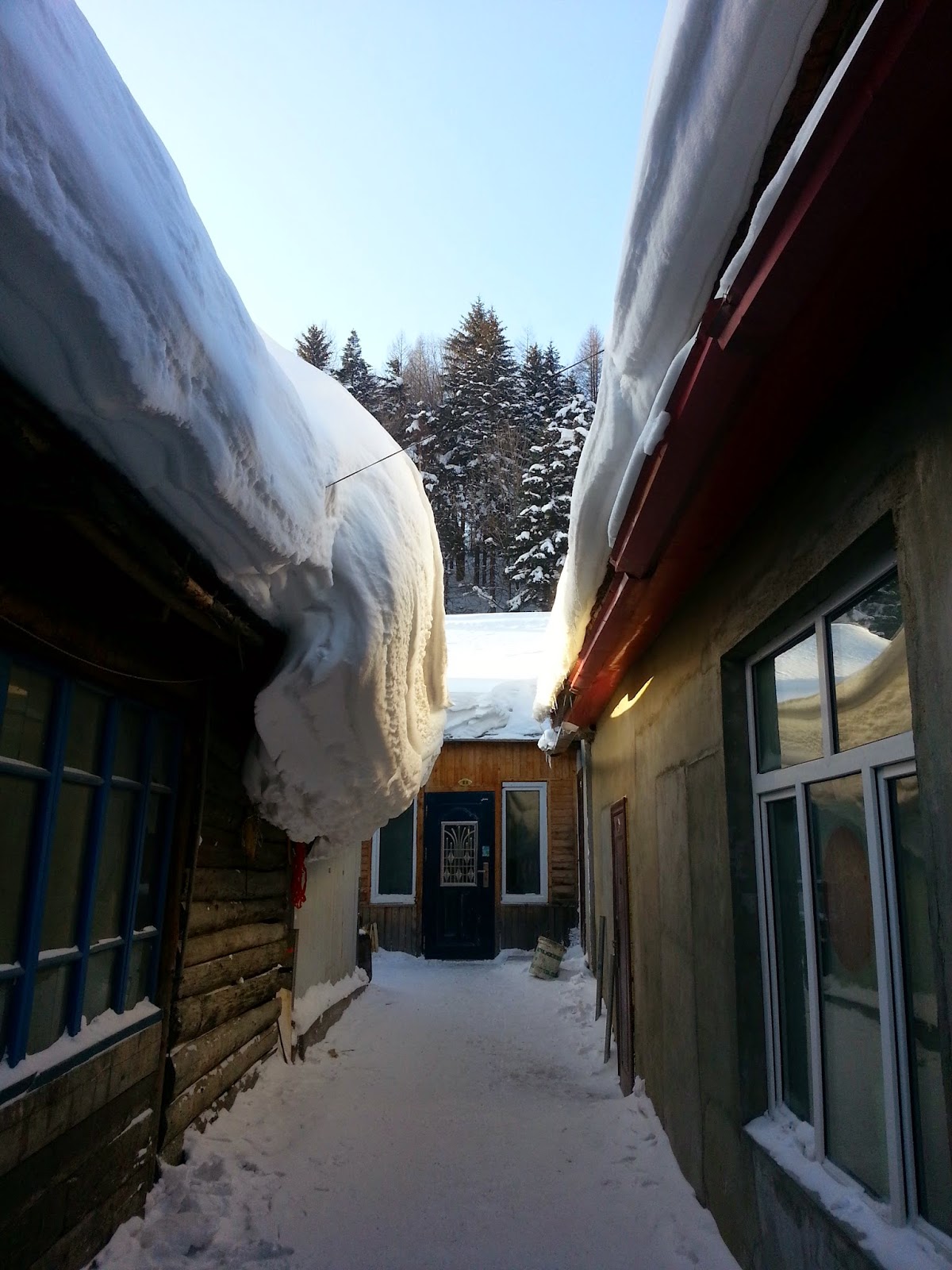
Outdoors I had to learn all about walking
in snow. I equate it with walking in sand at a beach. Until you set foot on a
soft patch of snow and fall in half a meter. Down to my hips I was just about
swimming around trees, trying to find more compact snow to walk on. I really
didn’t know how far down I could go but luckily no deeper than my hips.
The village straddled some small hills, covered in forest, but challenging to get to because of the snow. To me it seemed like the perfect escape from Chinese urbanization. A great place to get peace and quiet, something that doesn’t exist
in the hustle and bustle of Shanghai. It also defied what I knew about winter. Trees,
in -30degC, had shoots ready to pop once the sun warmed up a bit. Apart from
the crunch of snow beneath my feet, the woods were so quiet it was like a
non-China. Only for the wind, it was still and quiet, making it eiry.
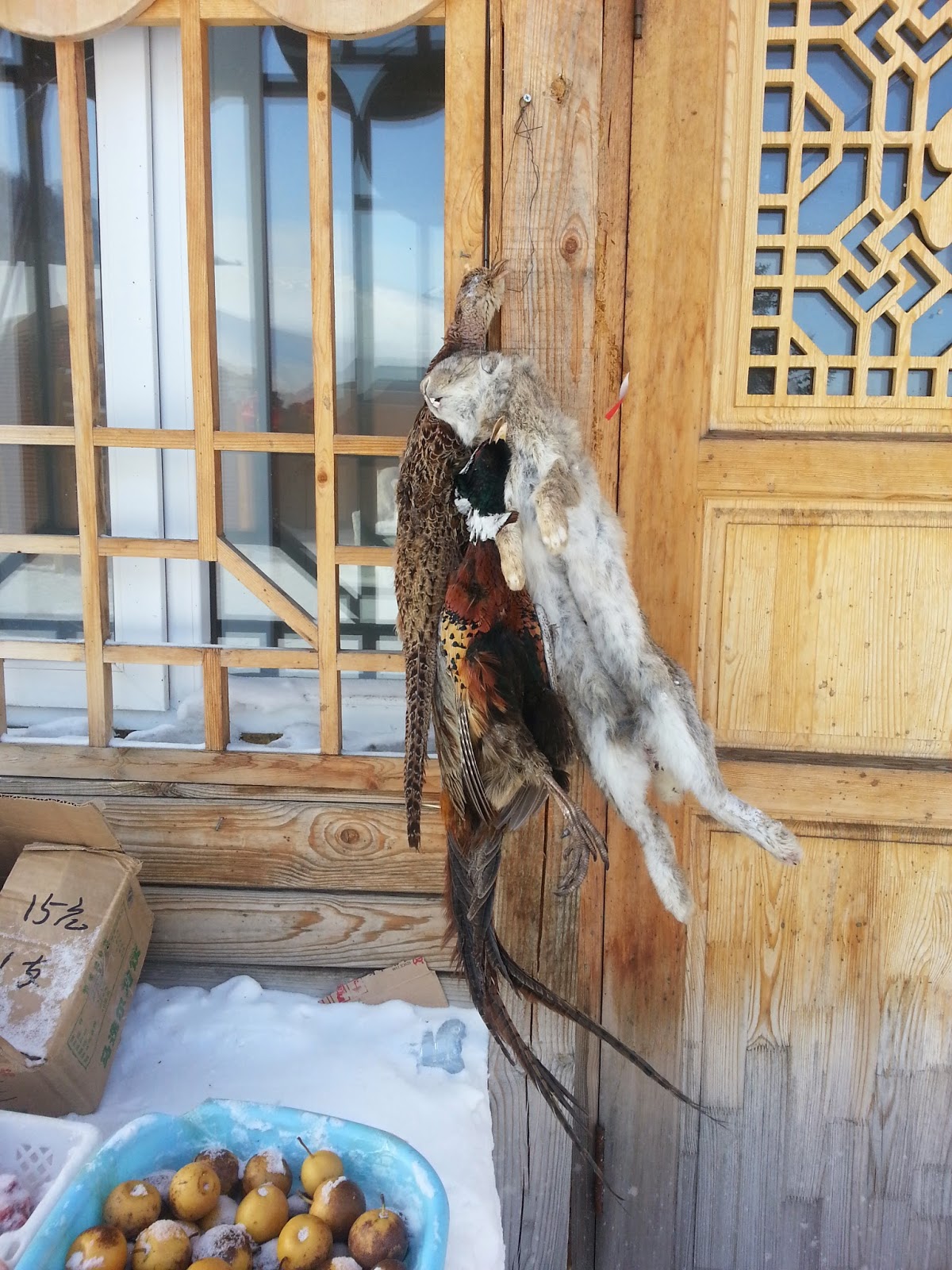
Beneath the hills, in the village, businesses sold ice-blocks on the street, kept frozen naturally by the temperature. A common traditional Chinese medicine belief is that if the weather is cold, eating cold things is good for the body. Judging by the number of tourists I saw eating ice-blocks at -30degC, I would say it's a popular belief. Another store had freshly-caught game hanging from the door. Frozen solid, the pheasant and rabbit were probably ready for the stew pot.
Men worked tirelessly with the snow, building fences and bridges of ice and igloo's. It was amazing to me to see how compact and hard ice could become if you worked with it. Or how you could build make-do luge tracks. This is one of my best memories in Dong-Bei, laying in a gigantic tire racing down a slope backwards.
It was fascinating to see in the
northern-most province of China how much Russian paraphernalia was sold. Dolls
and and vodka were the most popular buys for tourists. Classical music floated
around the downtown and St. Sophia Church was churning out a tune from Titanic.
Seeing a whole square of downtown designated for this Russian Orthodox church
was surprising, made the city seem more connected and legit with its
Soviet/Russian history. Iconic in Harbin, the church is emblematic of the
Russia-Dong Bei relationship. It has had its moments. Russians drowning
thousands of Chinese and the disconnect at the border. One side developed, the
other side forgotten about by a government in a very distant European city.
Dumplings and vodka were common at
mealtime. Meat is a vital part of the diet in Dong Bei as is a 3PM bottle of beer or
shot of vodka. A few times I came across Chinese fellas reeking of vodka or beer in the
mid-afternoon. A warmer I guess.


